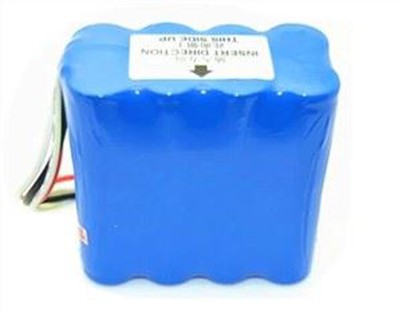



Newport HT70 Internal Battery BAT3205A
Compatible: BAT3205A
Payment terms: T/T, Western Union, Paypal
Shipping method: DHL, TNT, EMS, Fedex, UPS, by sea
Lead time: 3-7 working days
Samples are available
Description
BAT3205A HT70 Newport battery
Product Description
| Product name | Medical Rechargeable Battery |
| Cell of Origin | Panasonic |
| Brand Name | Pray-med |
| Certifications | CE/ISO |
| Size | 73.3*67*18.9mm |
| Nominal Capacity | 3100mAh |
| Weight | 192g |
| Type | LI-ION |
| Nominal Voltage | 14.4v |
| Application |
HT70 |
| Color | Black |
| Package | Individual box |
Compatibility
| Newport | HT70 |


| Technology | Lithium Ion |
| Life Time | 3 years or 500 charge-discharge cycles |
| Power | 65Wh |
| Rechargeable | Yes |
|
Capacity |
1Ah |


Shenzhen Pray- Med Technology Co., Ltd. has more than 10 years of experience in the industry.
Long-term focus on the development, design and research and development of medical consumables. Products are widely used in monitors, electrocardiographs, electroencephalograms, anesthesia machines, ventilators, ultrasound machines, physiotherapy equipment, etc.
With an industrial design department and its own R&D team, it can independently provide OEM/ODM customers with connector appearance designs for free.
The company has a 2000 square meter manufacturing base,
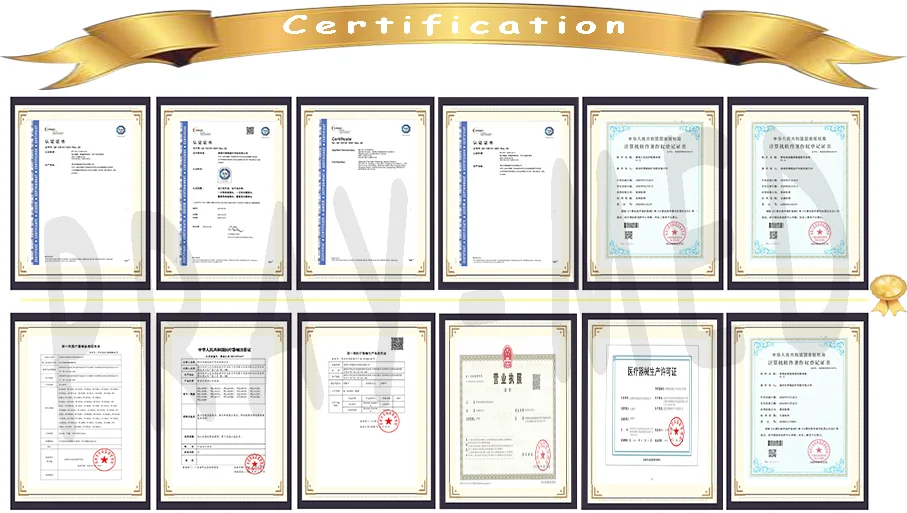
the products are ISO13485 certified by TUV, and all products have obtained CE certificates.
FAQS:
How long will my battery last?
The number of charge-discharge cycles that can be done to a battery ranges between 300 and 1000 times depending on the chemical of the battery. In addition after each charge-discharge cycle the runtime (time between charges) is reduced by intercalation as discussed above. For example you may notice in the first 3-4 months you are getting between 3-5 hours of runtime on your battery. Then in months 5-12 (after your purchase) you notice that you are slowly getting less and less runtime in between charges until you might be getting less than 5 minutes of runtime. This is the normal use of the chemistry inside your battery and DOES NOT mean that the battery is bad, but simply the chemical has been spent.
Should I charge my battery before I use it, each time I use it, and/or during storage?
Initial Charging: When you first get your battery you should charge it until your charger or device indicates that it is fully charged. If your device/charger does not indicate whether or not it is fully charged, then check your device/charger manual for charging times. It can take 1-12 hours to fully charge depending on the chemistry of your battery and the type of device and charger. After that it is good to charge it as needed while making sure you do not leave it at a low charge level for long periods. Also, please keep in mind that it can take 2-4 initial full charges/discharges before a new battery begins to provide maximum performance/runtime.
Recharging: Your battery was designed to be charged regularly and should NOT be left at a low charge level for long periods. You should charge it as often as needed to prevent the charge level from getting much below 15% of full.
What will cause my battery to lose power?
A battery over time degrades and eventually stops working. In fact the battery from its very first charge begins a very slow process that causes the battery to cease from functioning. Collectively the process is called battery degradation and power loss and it includes the following: declining capacity, increasing internal resistance, elevated self-discharge, and premature voltage cut-off on discharge.
Declining capacity is when the amount of charge a battery can hold gradually decreases due to usage, aging, and with some chemistry, lack of maintenance.
The loss of charge acceptance of the Li ion/polymer batteries is due to cell oxidation. Cell oxidation is when the cells of the battery lose their electrons. This is a normal process of the battery charge creation process. The capacity loss is permanent because the metals used in the cells run for a specific time only and are being consumed during their service life.
Internal resistance, known as impedance, determines the performance and runtime of a battery. It is a measure of opposition to a sinusoidal electric current. A high internal resistance curtails the flow of energy from the battery to a device. The aging of the battery cells contributes, primarily, to the increase in resistance as does cell oxidation. Interestingly energy may still be present in the battery, but it can no longer be delivered due to poor conductivity.
Elevated Self-discharge: All batteries have an inherent self-discharge. The self-discharge on nickel-based batteries is 10 to 15 percent of its capacity in the first 24 hours after charge, followed by 10 to 15 percent every month thereafter. Li-ion batteries self-discharge about five percent in the first 24 hours and one to two percent thereafter in the following months of use. At higher temperatures, the self-discharge on all battery chemistries increases. The self-discharge of a battery increases with age and usage. Once a battery exhibits high self-discharge, little can be done to reverse the effect. Be sure never to leave a rechargeable battery at low charge for long periods, even during storage. Click here for charging and recharging recommendations.
Premature Voltage Cut-Off: Some devices do not fully utilize the low-end voltage spectrum of a battery. A device may cut itself off before the designated end-of-discharge voltage is reached leaving battery power in the battery unused. For example, a pda that is powered with a single-cell Li ion battery and is designed to cut-off at 3.7V may actually cut-off at 3.3V. Obviously the full potential of the battery and the device is lost (not utilized). Why? It could be something with elevated internal resistance and or operations at warm ambient temperatures. Devices that load the battery with current bursts are more receptive to premature voltage cut-off than analog equipment. High cut-off voltage is mostly equipment related, not battery.

Hot Tags: newport ht70 internal battery bat3205a, manufacturers, suppliers, factory, cheap, buy
Send Inquiry
You Might Also Like